


Where Fashion Is Learned From the Inside Out
In an era where fashion often moves at the speed of content, there is something quietly different about a place that still teaches it by hand.
At Richard Robinson Fashion Design Academy in Ottawa, the focus is not on trend cycles or surface-level aesthetics. It is on construction, precision, and the discipline behind garments that are built to last. Founded in 1969, the academy remains Canada’s only institution dedicated exclusively to haute couture training, a distinction that shapes everything from its curriculum to its pace.
For students entering the full-time Fashion Designer program, the experience is immersive from the start.




A Foundation Built in the First Year
The first year is where the fundamentals take hold, and where most students quickly realize that fashion design is as technical as it is creative.
Time is divided across core disciplines that form the backbone of the craft. Fashion sketching introduces students to figure drawing through watercolour, pencil, and marker, developing the ability to communicate ideas visually. At the same time, pattern making builds technical understanding, from drafting to digital illustration using tools like Adobe Illustrator.
In the atelier, the work becomes more tactile. Haute couture sewing teaches intricate construction techniques, focusing on precision and finish rather than speed. Students learn how garments are assembled from the inside out, gaining an appreciation for structure that often goes unseen.
Alongside this, textiles and fashion history provide context. Fabric manipulation and material knowledge are paired with an understanding of how fashion has evolved over time, grounding design work in both technical and cultural awareness.
The rhythm is demanding. Students spend over twenty hours each week in class, supported by extensive independent work outside of it. But the intensity is intentional. It builds the discipline required to move into more advanced work.


Refinement and Identity in the Second Year
By the second year, the focus begins to shift.
Technical skills continue to develop, but there is a stronger emphasis on refinement and personal direction. Fashion sketching becomes more advanced, while pattern making and haute couture sewing move into more complex territory, pushing students to execute at a higher level.
New elements are introduced as well. Fashion marketing brings an understanding of branding, consumer behaviour, and positioning within the industry. Knit fabrics add another layer of technical complexity, expanding how students approach material and construction.

Most importantly, students begin working toward their final collection.
This is not a single garment, but a cohesive body of work. At least six complete looks, supported by a lookbook and presented in front of a panel, form the culmination of the program. It is both a creative statement and a demonstration of technical ability.
From Atelier to Runway
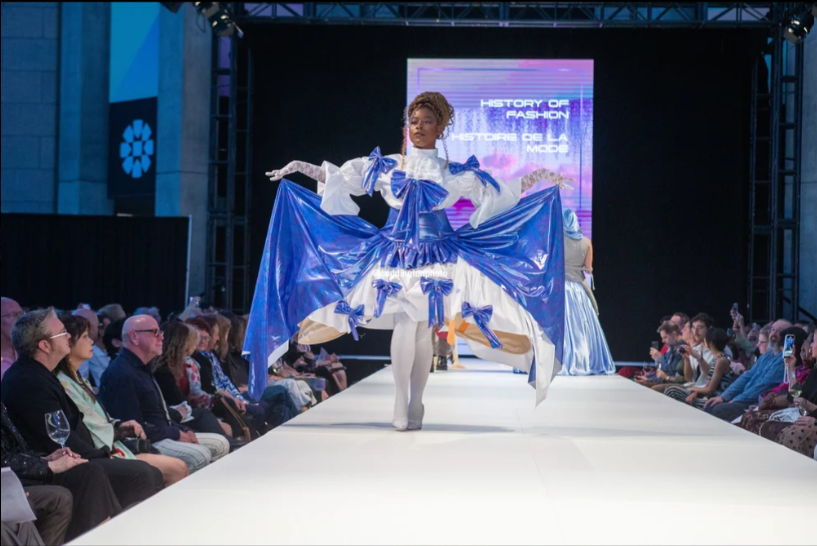
Throughout both years, students have the opportunity to present their work at the academy’s annual Grande Première fashion show.
Held each May, the event brings collections out of the studio and into a live setting, allowing students to see their designs worn, styled, and experienced in motion. It serves as a transition point between learning and professional presentation, reinforcing the standards expected within the industry.


A Different Pace of Learning
What distinguishes the program is not just its structure, but its philosophy.
With small class sizes and hands-on mentorship, the environment is closer to a working atelier than a traditional classroom. Students are guided closely through each stage of development, refining techniques and correcting details until the work meets a higher standard.
The academy also places a strong emphasis on sustainability through craftsmanship. Rather than producing quickly, students are trained to create garments that are made to last, both in construction and design. It is an approach rooted in slow fashion and responsible production, one that feels increasingly relevant in today’s industry.
Applications for September
The two-year full-time program begins each September, with the next intake scheduled for September 8, 2026. Admission is based on an entrance exam and interview, with applications currently open. Click Here To Apply
For those considering a future in fashion, the question often becomes what kind of designer they want to be.
At Richard Robinson Fashion Design Academy, the answer begins with learning the craft properly. Not just how clothing looks, but how it is built, refined, and brought to life.
Because in the end, the most enduring fashion is not the fastest made.
It is the most carefully constructed.